
In the intricate landscape of personal finance, few tools offer the same potent combination of tax advantages and long-term growth potential as the 401(k). For many Americans, it stands as the cornerstone of their retirement strategy, a powerful vehicle designed to transform today’s savings into tomorrow’s financial security. As we look ahead to 2026, understanding and strategically maximizing your 401(k) contributions becomes not just a smart move, but an imperative one for anyone serious about building a robust retirement nest egg. This comprehensive guide, focusing on a robust 401k Contribution Guide, will walk you through everything you need to know to optimize your savings, navigate the rules, and ensure you’re on the fast track to a comfortable retirement.
The allure of the 401(k) lies in its simplicity and its powerful benefits. Contributions are typically made pre-tax, meaning they reduce your taxable income in the year they are made, offering immediate tax savings. Your investments then grow tax-deferred, meaning you don’t pay taxes on earnings until retirement when you withdraw the funds. This deferred growth, especially when coupled with employer matching contributions, creates a compounding effect that can significantly accelerate your wealth accumulation. However, to truly harness this power, you must be proactive, informed, and strategic in your approach. This guide is your essential resource for mastering your 401(k) in 2026.
Anúncios
Understanding the 401(k) Landscape in 2026: Key Changes and Limits
Each year, the Internal Revenue Service (IRS) adjusts contribution limits for various retirement accounts, including the 401(k), to account for inflation and economic changes. Staying abreast of these changes is paramount to maximizing your savings. While the official 2026 limits are typically announced later in the preceding year, we can anticipate potential adjustments based on historical trends and economic forecasts. This section of our 401k Contribution Guide will provide an overview of what to expect and how to prepare.
Projected 2026 Contribution Limits
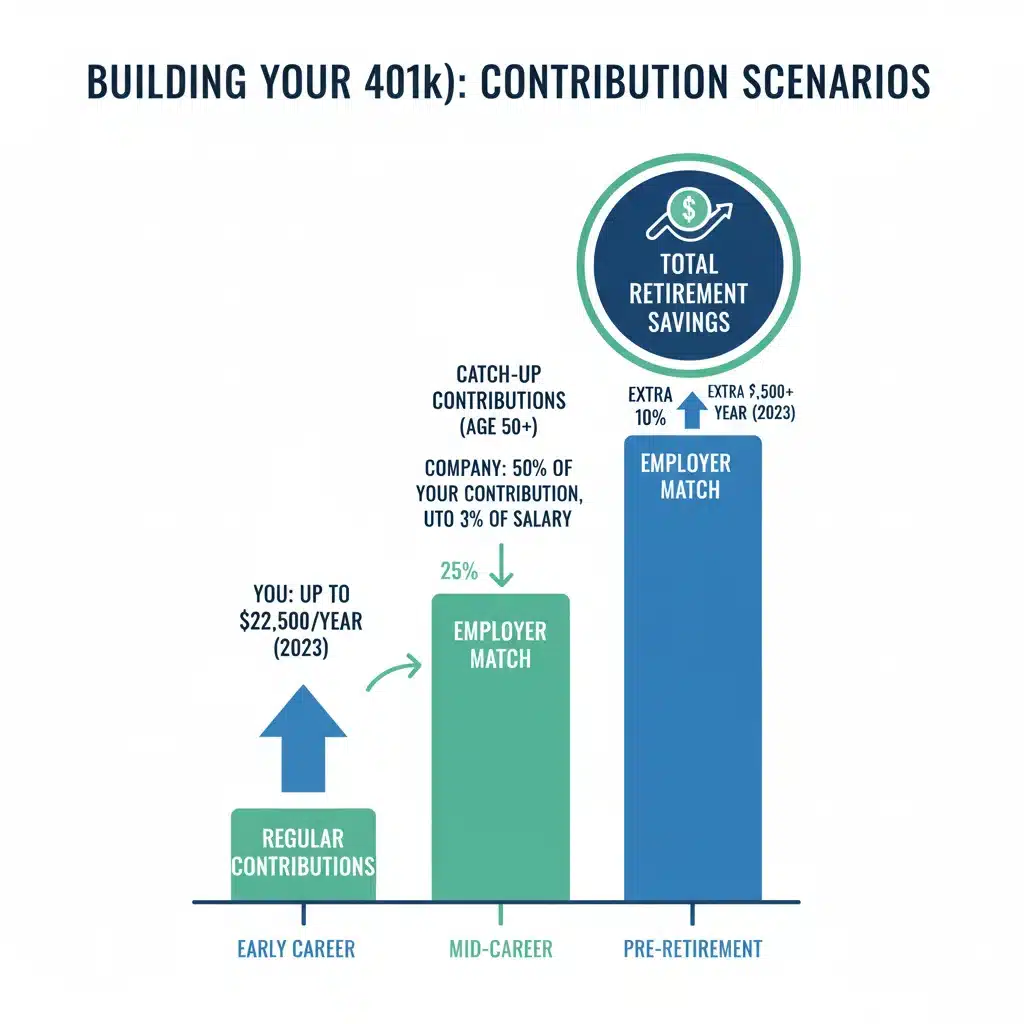
For 2025, the standard 401(k) employee contribution limit is $23,000. For individuals aged 50 and over, an additional catch-up contribution of $7,500 is permitted, bringing their total to $30,500. Based on inflation trends, it is highly probable that these limits will see a modest increase for 2026. While we await the official numbers, it’s wise to plan with the expectation of slightly higher limits. For instance, if the trend continues, the standard limit might rise to around $23,500 – $24,000, and the catch-up contribution could also see a small bump.
- Standard Employee Contribution Limit: This is the maximum amount an employee can contribute from their paycheck to their 401(k) in a given year. It’s crucial to hit this target if your financial situation allows.
- Catch-Up Contributions: For those aged 50 and older, the IRS allows additional contributions. This provision is a powerful tool for individuals who may have started saving later in life or want to significantly boost their retirement funds in their pre-retirement years.
- Total Contribution Limit (Employee + Employer): Beyond your personal contributions, there’s an overall limit on the total amount that can be contributed to your 401(k) from all sources (your contributions, employer matching, and profit-sharing contributions). This limit is significantly higher and also adjusts annually. Understanding this can be particularly important for high-income earners or those with generous employer plans.
It’s important to monitor official IRS announcements for the definitive 2026 figures. Once released, update your contribution strategy accordingly to ensure you’re always contributing the maximum allowable amount. This proactive approach is a cornerstone of any effective 401k Contribution Guide.
The Power of Maxing Out: Why It Matters
Why is it so frequently advised to max out your 401(k) contributions? The answer lies in the synergistic benefits of tax advantages, employer match, and the unparalleled power of compound interest. Let’s delve into why this strategy is so critical for long-term financial success.
Immediate Tax Savings
As mentioned, contributions to a traditional 401(k) are typically made pre-tax. This means the money you contribute is deducted from your gross income before taxes are calculated. For example, if you earn $70,000 annually and contribute $10,000 to your 401(k), your taxable income is reduced to $60,000. This immediate reduction in taxable income can lead to significant savings on your annual tax bill, effectively giving you a discount on your retirement savings.
Employer Matching Contributions: Free Money!
One of the most compelling reasons to contribute to your 401(k) is the employer match. Many companies offer to match a certain percentage of your contributions, up to a specific limit. For example, your employer might match 50 cents on the dollar for the first 6% of your salary you contribute. If you don’t contribute at least enough to get the full match, you are essentially leaving free money on the table. This is, without a doubt, the highest guaranteed return you’ll ever get on an investment. Prioritizing contributions to at least capture the full employer match is a non-negotiable step in any effective 401k Contribution Guide.
Tax-Deferred Growth and Compounding Returns
The magic of the 401(k) truly shines through its tax-deferred growth. Your investments grow over decades without being subject to annual taxes on dividends or capital gains. This allows your earnings to compound on themselves, accelerating your wealth accumulation exponentially. The earlier you start and the more you contribute, the more time your money has to benefit from this compounding effect. Even small differences in annual contributions can lead to vastly different outcomes over 20, 30, or 40 years.
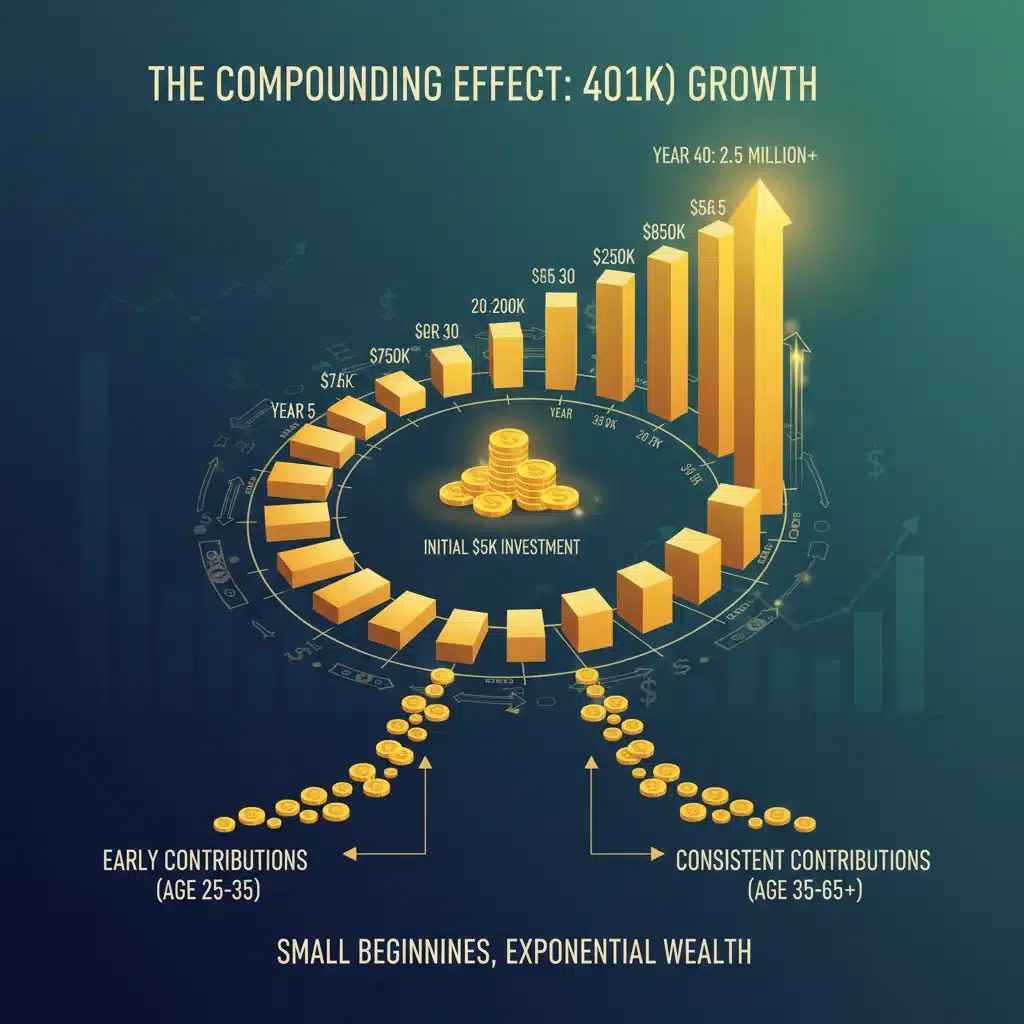
Consider two scenarios: Investor A starts contributing $5,000 per year at age 25, while Investor B starts contributing $5,000 per year at age 35. Assuming an average annual return of 7%, Investor A, by starting 10 years earlier, could have significantly more at retirement, even if both contribute the same total amount over their working lives. This illustrates the profound impact of time and compounding interest, making early and consistent contributions a cornerstone of a successful 401k Contribution Guide.
Strategies for Maximizing Your 2026 401(k) Contributions
Now that we understand the ‘why,’ let’s explore the ‘how.’ Maximizing your 401(k) contributions requires a strategic approach that considers your current financial situation, future goals, and available resources. Here are actionable strategies to help you reach your 2026 contribution goals.
1. Automate Your Contributions and "Set It and Forget It"
The easiest way to ensure consistent contributions is to automate them. Most 401(k) plans allow you to designate a percentage of each paycheck to go directly into your account. Set this percentage as high as you comfortably can, aiming for the maximum if possible. Once it’s set, you won’t miss the money, and your savings will grow on autopilot. This is a fundamental piece of advice in any practical 401k Contribution Guide.
2. Prioritize the Employer Match
As discussed, the employer match is free money. If you can only afford to contribute a certain amount, make sure that amount is at least enough to capture the full employer match. This should be your absolute minimum contribution target.
3. Implement the "Raise Rule"
Whenever you receive a raise, bonus, or any increase in income, commit to increasing your 401(k) contribution by at least half of that raise (or even the full amount!). This strategy allows you to boost your savings without feeling a significant pinch in your take-home pay, as you’re already accustomed to living on your previous income level. This incremental approach is often the most sustainable way to reach maximum contribution levels.
4. Utilize Catch-Up Contributions (Age 50+)
If you are 50 or older, take full advantage of the catch-up contribution provision. This extra allowance can significantly boost your retirement savings in the years leading up to retirement, helping you compensate for any periods where you might have under-contributed. It’s a critical component of a late-stage 401k Contribution Guide.
5. Review and Adjust Annually
Don’t just set your contributions and forget them forever. Make it a habit to review your 401(k) contributions and overall financial plan at least once a year, ideally at the beginning of the year or after the IRS announces new limits. This allows you to adjust your contributions upwards as limits increase, or as your income and financial situation improve.
6. Understand Your Investment Options
While contributing is vital, how your money is invested within the 401(k) also plays a crucial role. Most plans offer a range of investment options, from target-date funds to various mutual funds and exchange-traded funds (ETFs). Take the time to understand these options, assess your risk tolerance, and choose investments that align with your long-term goals. If you’re unsure, target-date funds are a popular choice as they automatically adjust their asset allocation as you approach retirement. For more personalized advice, consider consulting a financial advisor.
7. Consider a Roth 401(k) Option
Some employers offer a Roth 401(k) option. Unlike a traditional 401(k) where contributions are pre-tax and withdrawals are taxed in retirement, Roth 401(k) contributions are made with after-tax dollars. The significant advantage is that qualified withdrawals in retirement are entirely tax-free. This can be particularly appealing if you anticipate being in a higher tax bracket in retirement than you are today. The decision between a traditional and Roth 401(k) depends on your individual tax situation and future expectations, and it’s a key consideration within a comprehensive 401k Contribution Guide.
Overcoming Obstacles to Maximizing Contributions
It’s easy to say "max out your 401(k)," but the reality for many people involves competing financial priorities. Here’s how to address common challenges.
Budgeting and Finding Extra Funds
If you’re struggling to find extra money to contribute, a thorough review of your budget is in order. Look for areas where you can cut back, even temporarily. Small sacrifices today can lead to substantial gains in retirement. Consider the "latte factor" – those small, daily expenses that add up over time. Redirecting even $10-$20 a week can make a difference. Tools like budgeting apps or spreadsheets can help you identify these opportunities.
Managing Other Debts
The question often arises: should I pay off debt or contribute to my 401(k)? The answer isn’t always straightforward and depends on the type and interest rate of your debt. Generally, if you have high-interest debt (e.g., credit card debt with rates above 8-10%), it often makes sense to prioritize paying that down. However, always contribute enough to your 401(k) to get the full employer match, as that’s an immediate, guaranteed return that usually outweighs even high-interest debt. Once the high-interest debt is under control, then aggressively pursue maximum 401(k) contributions.
Emergency Fund First
Before aggressively investing for retirement, ensure you have a solid emergency fund in place. This typically means 3-6 months’ worth of living expenses saved in an easily accessible, liquid account. An emergency fund prevents you from having to tap into your 401(k) (and incur penalties) if an unexpected expense arises. This foundational step is crucial before diving deep into a 401k Contribution Guide.
The Long-Term Impact: What Maxing Out Your 401(k) Means for Your Retirement
Let’s put some numbers to the power of maximizing your 401(k) contributions. While specific returns are never guaranteed, historical market averages provide a valuable benchmark.
Illustrative Scenario: The Power of Consistent Max Contributions
Imagine a 30-year-old individual in 2026 earning $80,000 annually, with an employer match of 50% on the first 6% of salary. Let’s assume the 2026 individual contribution limit is $24,000, and they consistently max out their contributions each year until age 65 (35 years), with an average annual market return of 7%.
- Annual Employee Contribution: $24,000
- Employer Match: $80,000 * 6% * 50% = $2,400
- Total Annual Contribution: $26,400
- Total Contributions Over 35 Years: $26,400 * 35 = $924,000
With a 7% average annual return, this individual’s 401(k) could grow to approximately $3.9 million by age 65. This dramatic difference between total contributions and the final account balance is a testament to the power of compounding and consistent, maximized contributions. If this individual only contributed enough to get the employer match ($4,800 personal + $2,400 match = $7,200 annually), their account balance would be significantly lower, around $1.1 million – a substantial difference of $2.8 million!
This hypothetical scenario underscores the immense benefit of pushing your contributions to the limit. It’s not just about saving; it’s about leveraging the system to generate substantial wealth for your future. This kind of long-term vision is what drives every recommendation in this 401k Contribution Guide.
Advanced 401(k) Considerations
Beyond the basics, there are a few more advanced points to consider as you refine your 401(k) strategy.
Diversification Within Your 401(k)
While the 401(k) is a powerful vehicle, remember that it’s just one component of your overall financial portfolio. Ensure your investments within your 401(k) are diversified across different asset classes (stocks, bonds, real estate, etc.) to mitigate risk. Furthermore, consider how your 401(k) fits into your broader investment strategy, including any IRAs, taxable brokerage accounts, or other savings vehicles.
Understanding Vesting Schedules
If your employer provides matching contributions, they often come with a vesting schedule. This means you must work for the company for a certain period before you fully own the employer-contributed funds. If you leave before you are fully vested, you may forfeit some or all of the employer match. Understand your company’s vesting schedule, as it can influence job change decisions.
Loans and Hardship Withdrawals
While your 401(k) is primarily for retirement, some plans allow you to take out a loan against your balance or make a hardship withdrawal in dire circumstances. While these options exist, they should generally be considered a last resort. Loans must be repaid with interest (which you pay back to your own account, but you lose out on potential market gains), and hardship withdrawals are often subject to taxes and penalties, significantly hindering your retirement progress. The goal of this 401k Contribution Guide is to help you avoid such situations through proactive planning.
Rolling Over Old 401(k)s
If you’ve changed jobs multiple times, you likely have several old 401(k) accounts. It’s often beneficial to consolidate these into your current 401(k) (if allowed and beneficial), or roll them over into an IRA. Consolidating makes it easier to manage your investments, track performance, and maintain a clear picture of your retirement savings. Carefully research the fees and investment options before making any rollover decisions.
The Importance of Professional Guidance
While this 401k Contribution Guide provides a wealth of information, personal finance is, by its very nature, personal. Your unique circumstances, risk tolerance, and long-term goals may warrant tailored advice. Consulting a qualified financial advisor can be invaluable. An advisor can help you:
- Assess your current financial situation and set realistic retirement goals.
- Develop a comprehensive financial plan that integrates your 401(k) with other savings and investment strategies.
- Choose appropriate investment options within your 401(k) based on your risk profile and time horizon.
- Navigate complex tax implications and optimize your overall tax strategy.
- Stay on track with your contributions and make adjustments as life circumstances change.
Even a one-time consultation can provide clarity and confidence in your retirement planning efforts.
Conclusion: Your Path to a Secure Retirement Starts Now
Maximizing your 401(k) contributions in 2026 is one of the most impactful financial decisions you can make for your future. It’s a commitment to leveraging tax advantages, harnessing the power of employer matching, and allowing compound interest to work its magic over decades. By understanding the contribution limits, implementing smart savings strategies, and staying informed about your investment options, you are actively building a foundation for a financially secure and comfortable retirement.
Don’t underestimate the long-term impact of consistent, disciplined saving. The decisions you make today regarding your 401(k) will profoundly shape your financial well-being in the future. Use this 401k Contribution Guide as your roadmap, commit to taking action, and embark on your journey to retirement success with confidence. Start today, review your plan regularly, and watch your retirement dreams take shape.