Inflation’s Grip: Protecting Your 2026 Retirement Savings
Anúncios
The Impact of Current Inflation (6.2% Annually) on Your 2026 Retirement Savings
The dream of a comfortable retirement is a goal many diligently work towards throughout their lives. Saving, investing, and planning are crucial components of building a robust financial future. However, external economic forces can significantly alter the trajectory of even the most well-laid plans. One such formidable force currently at play is inflation, specifically the current annual rate of 6.2%. For those eyeing retirement in 2026, understanding and mitigating the impact of this sustained inflation on your inflation retirement savings is not just advisable, it’s absolutely critical.
Inflation, in essence, is the rate at which the general level of prices for goods and services is rising, and consequently, the purchasing power of currency is falling. A 6.2% annual inflation rate means that what $100 could buy today will cost approximately $106.20 next year. Over several years, this erosion of purchasing power can significantly diminish the real value of your accumulated savings, potentially leaving you with far less financial security than you anticipated in your golden years.
Anúncios
This comprehensive guide will delve deep into the mechanics of how a 6.2% inflation rate can specifically affect your 2026 retirement savings, explore the various ways your portfolio might be vulnerable, and most importantly, provide actionable strategies and insights to protect and even grow your wealth amidst these challenging economic conditions. We will cover everything from understanding the silent thief that is inflation to specific investment vehicles and behavioral adjustments you can make to safeguard your future.
Understanding the Silent Threat: How 6.2% Inflation Erodes Your Wealth
Inflation is often referred to as a ‘silent tax’ because it reduces the purchasing power of your money without any explicit deduction. While a 6.2% annual inflation rate might not sound immediately alarming to everyone, its compounding effect over time can be devastating, especially for long-term goals like retirement. For someone planning to retire in 2026, this means that every year between now and then, the value of their existing savings and future contributions will be chipped away.
Let’s put this into perspective. If you have $500,000 saved today for retirement, and inflation continues at 6.2% annually, by 2026 (assuming a three-year horizon), the purchasing power of that $500,000 will be significantly reduced. Specifically, its real value would be approximately $415,000 in today’s dollars. This is a substantial reduction, meaning your retirement lifestyle might need to be drastically scaled back, or you might need to work longer than planned. This is the direct impact on your inflation retirement savings.
The components of your retirement savings are affected differently. Cash holdings, for instance, are the most vulnerable. Money sitting in a low-interest savings account, earning less than the inflation rate, is losing value every single day. Fixed-income investments like traditional bonds also suffer, as their fixed coupon payments buy less and less over time. Even growth-oriented investments, if they don’t outpace inflation, are effectively losing ground in real terms.
The psychological impact of inflation is also important. As prices rise, the cost of living increases, meaning your monthly expenses in retirement will be higher than anticipated. This necessitates a larger nest egg than originally calculated, making the task of accumulating sufficient inflation retirement savings even more challenging.
It’s crucial to acknowledge that inflation is not a uniform phenomenon. Different goods and services inflate at different rates. Essential items like food, energy, and healthcare often see higher price increases, which can disproportionately affect retirees who typically spend a larger percentage of their income on these necessities. Therefore, a 6.2% average inflation rate might even understate the real impact on a retiree’s specific basket of goods and services.
Assessing the Damage: How 2026 Retirement Plans are Affected
For those targeting 2026 for retirement, the window to adjust strategies is relatively short, making proactive measures even more vital. The 6.2% annual inflation rate directly impacts several aspects of your retirement planning:
Reduced Purchasing Power of Savings
As discussed, the most immediate effect is the erosion of your accumulated wealth. The money you’ve saved will simply not buy as much in 2026 as it does today. This means your projected income streams from investments, pensions, or Social Security will have less real value, potentially leading to a lower standard of living in retirement.
Increased Cost of Living
The cost of everything from groceries to healthcare, housing, and leisure activities will be higher. Your retirement budget, which you meticulously planned years ago, might now be insufficient. This necessitates a re-evaluation of your expected monthly expenses in retirement and a recalibration of how much you need to save.
Impact on Fixed Income Streams
If a significant portion of your retirement income is derived from fixed sources like annuities, pensions (without cost-of-living adjustments), or traditional bonds, their real value will decline significantly. This makes it harder to maintain your lifestyle as the years progress. Understanding the composition of your expected retirement income is key to assessing this risk to your inflation retirement savings.
Pressure on Investment Returns
To simply maintain the purchasing power of your investments, your portfolio needs to generate returns greater than 6.2% annually. This is a high bar, especially in a volatile market environment. Investments that historically provided adequate returns might now be underperforming in real terms, requiring a shift in strategy towards assets that offer better inflation protection.
Social Security Considerations
While Social Security benefits typically include a Cost-of-Living Adjustment (COLA), these adjustments might not always fully keep pace with the actual inflation experienced by retirees. Furthermore, the timing of these adjustments can mean a lag in benefits catching up to rising prices, creating short-term financial strain. Relying solely on Social Security for inflation protection is a risky proposition for your inflation retirement savings.
Strategic Defense: Protecting Your Inflation Retirement Savings
Facing a 6.2% annual inflation rate, a passive approach to your retirement savings is no longer viable. Proactive and strategic adjustments are essential. Here are key strategies to consider:
1. Re-evaluating Your Asset Allocation
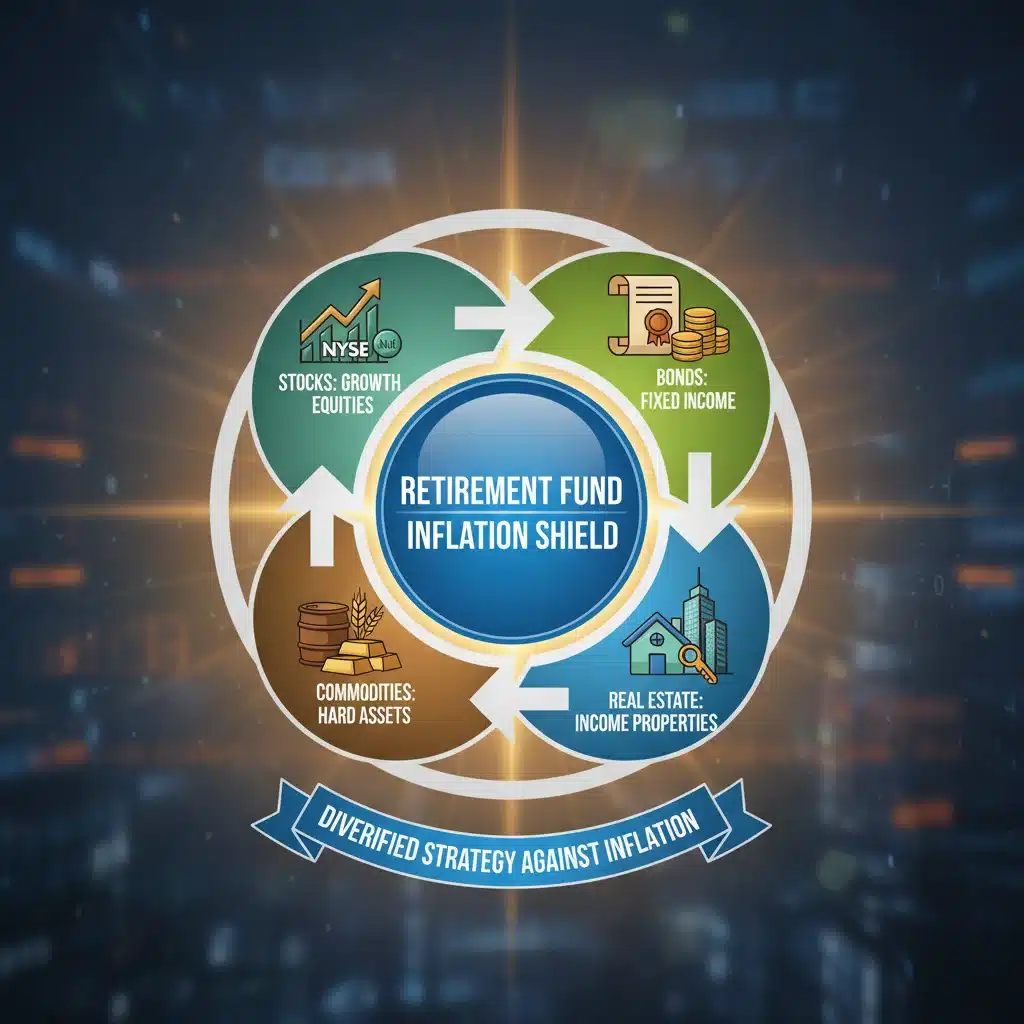
This is perhaps the most critical step. Your current asset allocation might be suitable for a low-inflation environment but could be detrimental in the face of persistent 6.2% inflation. You need to shift towards assets that historically perform well or offer protection during inflationary periods.
- Equities (Stocks): Historically, stocks have been one of the best hedges against inflation over the long term. Companies can often pass on increased costs to consumers through higher prices, leading to increased revenues and earnings. Focus on companies with strong pricing power, robust balance sheets, and essential products or services.
- Real Estate: Property values and rental income tend to rise with inflation. Investing in real estate directly, through REITs (Real Estate Investment Trusts), or even through real estate funds can provide a hedge.
- Commodities: Raw materials like oil, gold, silver, and agricultural products often see their prices increase during inflationary times. Diversifying a small portion of your portfolio into commodities or commodity-linked investments can offer protection.
- Inflation-Indexed Securities: Treasury Inflation-Protected Securities (TIPS) are government bonds whose principal value adjusts with inflation, as measured by the Consumer Price Index (CPI). This makes them a direct hedge against inflation risk.

2. Diversification Beyond Traditional Assets
While traditional asset classes are important, consider broadening your diversification to include alternative investments that might thrive in an inflationary environment.
- Private Equity/Debt: These can offer returns that are less correlated with public markets and may include inflation-hedging clauses in their agreements.
- Infrastructure Investments: Assets like toll roads, utilities, and communication towers often have stable cash flows and contracts that are indexed to inflation.
- Cryptocurrencies: While highly volatile, some view certain cryptocurrencies as a hedge against fiat currency devaluation, though this comes with significant risk and is not suitable for all investors.
3. Maximizing Contributions and Catch-Up Provisions
With only a few years until 2026, boosting your savings rate is crucial. Maximize contributions to tax-advantaged accounts like 401(k)s and IRAs. If you are 50 or older, take advantage of catch-up contributions, which allow you to contribute additional amounts beyond the standard limits. These extra contributions, when invested strategically, can help offset the effects of inflation on your inflation retirement savings.
4. Reviewing Your Retirement Budget and Spending Habits
Revisit your projected retirement budget. Factor in higher costs for everyday expenses, healthcare, and leisure. If your current savings trajectory doesn’t meet the revised needs, you might need to adjust your spending habits now to free up more funds for saving and investing. Consider delaying retirement slightly if necessary, to allow more time for your investments to grow and for additional contributions.
5. Considering Annuities with Inflation Protection
Some annuities offer riders or features that provide inflation protection, such as cost-of-living adjustments (COLAs). While annuities can be complex and come with fees, exploring options that guarantee a rising income stream can be a valuable component of your overall strategy, especially for covering essential expenses in retirement.
6. Minimizing Debt
High-interest debt becomes even more burdensome during inflationary periods. Prioritize paying down consumer debt, credit card balances, and even mortgages if possible, before retirement. Reducing your fixed expenses means you’ll need less income in retirement, making your existing inflation retirement savings stretch further.
7. Consulting a Financial Advisor
Navigating an inflationary environment, especially with a specific retirement timeline like 2026, can be complex. A qualified financial advisor can help you assess your current situation, understand your risk tolerance, and tailor an investment strategy that specifically addresses the challenges posed by 6.2% inflation. They can provide personalized advice on asset allocation, tax-efficient strategies, and income planning to protect your inflation retirement savings.
Long-Term Perspective: Beyond 2026
While the immediate focus is on protecting your 2026 retirement savings from current inflation, it’s also important to consider the long-term implications. Inflation is not a one-time event; it can fluctuate over time. Therefore, building a resilient portfolio that can withstand various economic cycles is paramount.
Even after you retire, inflation will continue to erode the purchasing power of your income. It’s vital to have an income strategy that accounts for this ongoing challenge. This might involve a ‘bucket strategy,’ where different portions of your portfolio are allocated to provide income for different time horizons, with longer-term buckets invested in growth assets that can outpace inflation.
Regularly reviewing your financial plan, even in retirement, is crucial. Economic conditions change, and your spending habits might evolve. An annual review with a financial advisor can ensure your strategy remains aligned with your goals and the prevailing economic climate, protecting your inflation retirement savings throughout your retirement years.
Case Study: A Hypothetical Scenario for 2026 Retirees
Let’s consider a hypothetical couple, John and Mary, both 63, planning to retire in early 2026. They currently have $1,200,000 in their combined retirement accounts, primarily invested in a traditional 60/40 stock/bond portfolio. Their initial retirement budget projected $60,000 per year in today’s dollars, excluding Social Security.
With 6.2% annual inflation, here’s how their situation might change:
- Purchasing Power Erosion: If their $1.2 million were to simply sit, its real value by 2026 would be closer to $996,000 (after three years of 6.2% inflation), a loss of over $200,000 in purchasing power.
- Increased Living Costs: Their projected $60,000 annual expenses would likely be closer to $71,700 by 2026 due to inflation. This means they need a larger income stream just to maintain their planned lifestyle.
- Investment Performance: If their 60/40 portfolio only yields, say, 4% annually nominal, they are losing 2.2% in real terms each year. Their inflation retirement savings are shrinking.
John and Mary’s Action Plan:
- Consult a Financial Advisor: They meet with an advisor to re-evaluate their risk tolerance and asset allocation.
- Adjust Asset Allocation: They decide to increase their equity exposure slightly, focusing on dividend-paying stocks with strong pricing power. They also allocate a small portion to a TIPS fund and a broad-market commodity ETF for better inflation hedging.
- Maximize Contributions: Both John and Mary take advantage of catch-up contributions to their 401(k)s for the remaining working years, adding an extra $7,000 each per year.
- Budget Review: They scrutinize their pre-retirement spending, cutting down on non-essential expenses to save an additional $500 per month.
- Consider Part-Time Work: John, an accountant, explores the possibility of working part-time for the first year of retirement to ease the transition and supplement income while their portfolio continues to grow.
By implementing these strategies, John and Mary are proactively working to mitigate the impact of 6.2% inflation, aiming to secure their desired retirement lifestyle in 2026 and beyond. This hypothetical scenario underscores the importance of a dynamic approach to managing your inflation retirement savings.
Conclusion: Taking Control of Your Retirement Future
The current 6.2% annual inflation rate presents a significant challenge for anyone planning to retire in 2026. However, it is not an insurmountable obstacle. By understanding the mechanisms through which inflation erodes wealth and by implementing strategic adjustments to your financial plan, you can protect and even enhance your inflation retirement savings.
The key is to be proactive, informed, and adaptable. Re-evaluate your asset allocation, consider inflation-indexed investments, maximize your savings, review your budget, and don’t hesitate to seek professional guidance. Your retirement dream is too important to leave to chance in an unpredictable economic climate. By taking decisive action now, you can ensure that your hard-earned savings provide the comfortable and secure retirement you’ve envisioned for 2026 and many years to come.
Remember, financial planning is an ongoing process. Regular reviews and adjustments are crucial to staying on track, especially when economic conditions shift. Empower yourself with knowledge and make informed decisions to safeguard your financial future against the silent threat of inflation.