Maximize Social Security 2026: Boost Your Monthly Payments

Anúncios
In the evolving landscape of retirement planning, understanding and strategically approaching your Social Security benefits is more crucial than ever. For those approaching retirement in 2026, or even those still years away, grasping the nuances of how to maximize social security payments can lead to a significantly more comfortable and secure financial future. This comprehensive guide will delve into the critical strategies and considerations for optimizing your Social Security benefits, potentially increasing your monthly payments by up to 8% or more.
The Social Security Administration (SSA) provides a vital safety net for millions of Americans, but the system is complex. Many individuals leave money on the table simply because they are unaware of the rules, claiming strategies, and potential pitfalls. Our goal here is to demystify these complexities and equip you with the knowledge to make informed decisions that will directly impact your financial well-being in retirement. We’ll explore everything from the optimal claiming age to understanding spousal and survivor benefits, and how your work history plays a pivotal role.
Anúncios
The year 2026 is particularly significant for a cohort of retirees who will reach their Full Retirement Age (FRA) or are considering their claiming options. The decisions made around this time can have a lasting impact on the total benefits received over a lifetime. Therefore, a proactive and well-researched approach is not just beneficial, but essential. Let’s embark on this journey to ensure you are well-prepared to maximize social security benefits for your retirement.
Understanding Your Full Retirement Age (FRA) and Its Impact
One of the most fundamental aspects of maximizing your Social Security benefits revolves around your Full Retirement Age (FRA). Your FRA is the age at which you are entitled to receive 100% of your primary insurance amount (PIA). This age is determined by your birth year. For anyone born in 1960 or later, your FRA is 67. If you were born between 1943 and 1954, your FRA was 66. For those born between 1955 and 1959, your FRA gradually increases by a few months each year until it reaches 67. Knowing your specific FRA is the cornerstone of any effective Social Security claiming strategy.
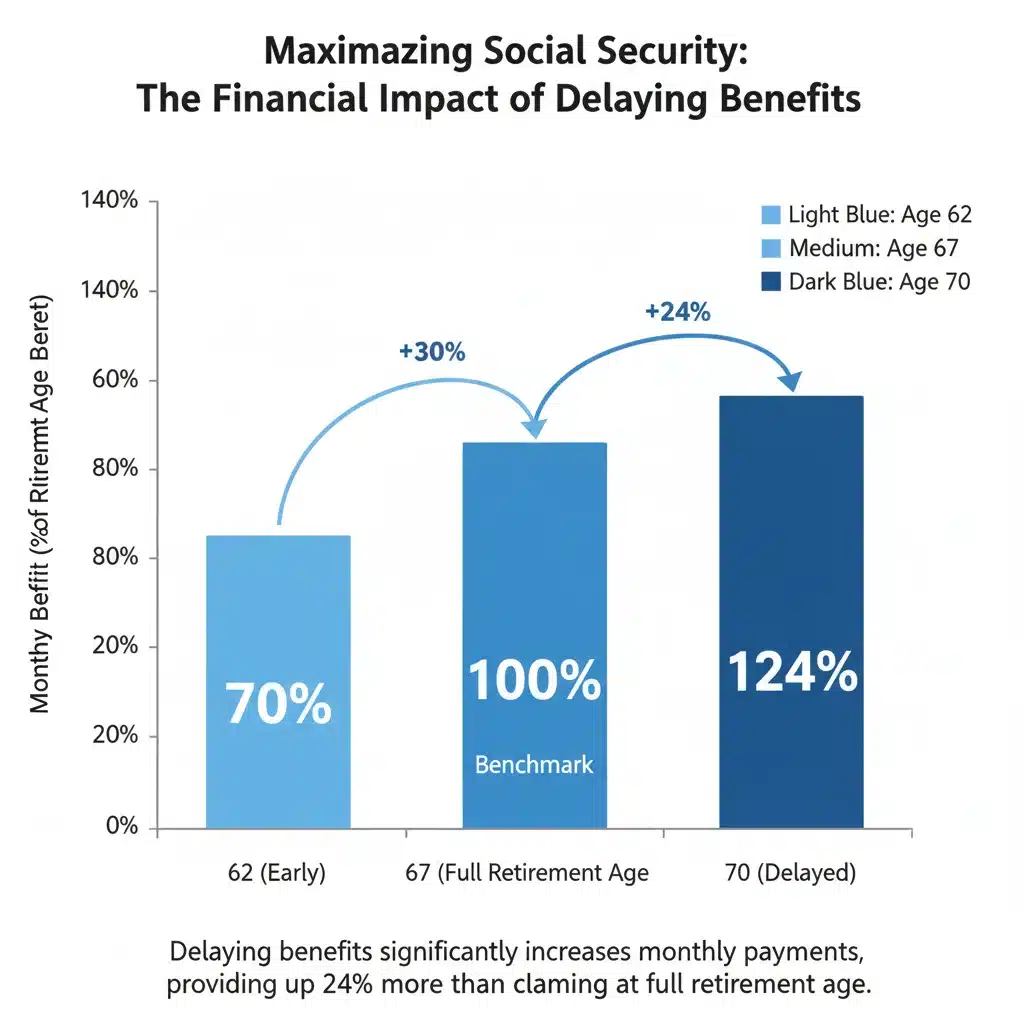
Claiming benefits before your FRA results in a permanent reduction of your monthly payments. For example, if your FRA is 67 and you claim at age 62, your benefits could be reduced by as much as 30%. Conversely, delaying your claim past your FRA can significantly increase your monthly payments. For each year you delay claiming benefits past your FRA, up to age 70, you earn an 8% increase in your annual benefit, known as Delayed Retirement Credits (DRCs). This 8% annual increase is a powerful incentive to consider delaying, as it can substantially maximize social security payments over your lifetime.
Consider an individual whose FRA is 67. If they claim at 67, they receive 100% of their PIA. If they delay until 68, their benefit increases by 8%; at 69, another 8% increase; and at 70, a final 8% increase, totaling a 24% increase over their FRA benefit. This means that an individual who delays claiming from 67 to 70 could see their monthly payment increase by a substantial amount, making a significant difference in their retirement income. This strategy is particularly effective for those who are in good health and have other sources of income to support them until age 70.
The decision of when to claim is highly personal and depends on various factors, including your health, financial needs, and other retirement income sources. However, understanding the direct correlation between claiming age and benefit amount is the first crucial step in any effort to maximize social security.
The Power of Delayed Retirement Credits: Boosting Your Benefits by 8% Annually
As mentioned, Delayed Retirement Credits (DRCs) are perhaps the most potent tool available to increase your Social Security benefits. For each year you defer receiving benefits after your Full Retirement Age (FRA) and up to age 70, your monthly benefit grows by 8%. This annual increase is guaranteed and compounds, making it an incredibly attractive option for those who can afford to wait. This strategy is central to how to maximize social security for many retirees.
Let’s illustrate with an example: Sarah, born in 1960, has an FRA of 67. Her Primary Insurance Amount (PIA) at age 67 is $2,000 per month. If Sarah delays claiming until age 68, her benefit will be $2,000 + (0.08 * $2,000) = $2,160. If she delays until age 69, it becomes $2,160 + (0.08 * $2,160) = $2,332.80. And if she waits until age 70, her benefit will be $2,332.80 + (0.08 * $2,332.80) = $2,519.42. That’s a 26% increase over her FRA benefit, not considering the slight variations in calculation by the SSA which might make it closer to 24% for the cumulative 3 years. This substantial increase can provide a significant boost to her retirement income for the rest of her life.
It’s important to note that DRCs stop accumulating at age 70. There is no additional benefit to delaying past your 70th birthday. Therefore, age 70 is generally considered the optimal age to begin receiving benefits if your primary goal is to maximize social security monthly payments.
However, delaying is not without its considerations. While the monthly payment will be higher, you will forgo several years of benefits. The break-even point, where the cumulative benefits from delaying catch up to the cumulative benefits from claiming earlier, typically falls in your late 70s or early 80s. This means that if you anticipate a shorter lifespan due to health issues, claiming earlier might be a more suitable strategy. Conversely, if you expect to live a long life, delaying until 70 is often the best approach to maximize social security lifetime benefits.
To make an informed decision, it’s advisable to use the Social Security Administration’s online tools and calculators, or consult with a financial advisor who specializes in retirement planning. They can help you project your total benefits under different claiming scenarios and assess the impact on your overall financial plan. The goal is to make a decision that aligns with your personal circumstances and helps you effectively maximize social security for your unique situation.
Understanding Your Work History and Earnings Record
Your Social Security benefits are calculated based on your average indexed monthly earnings (AIME) during your 35 highest-earning years. This means that the amount you earn throughout your career directly impacts your future Social Security payments. To effectively maximize social security, understanding and monitoring your earnings record is paramount.
The SSA uses a complex formula to calculate your PIA, which is the amount you would receive at your FRA. This formula takes your 35 highest-earning years, adjusts them for inflation (indexing), and then averages them. If you have fewer than 35 years of earnings, the missing years are counted as zero, which can significantly lower your average and, consequently, your benefit amount. This is a critical point for individuals who have taken time off for caregiving, education, or other reasons. Working a few extra years to replace those zero-earning years with higher-earning years can dramatically increase your PIA and help you maximize social security.
It’s also crucial to regularly review your Social Security Statement, which you can access online through your My Social Security account. This statement provides a detailed record of your earnings history as reported to the SSA. Errors in this record, such as missing earnings or incorrect amounts, can negatively impact your future benefits. Identifying and correcting these errors promptly is essential. If you find discrepancies, gather documentation like W-2s or tax returns to prove your earnings and contact the SSA to have your record corrected. Ensuring an accurate earnings record is a foundational step to maximize social security.
For those still working, especially in their peak earning years, continuing to work can have a dual benefit. Not only does it allow you to delay claiming and accrue DRCs, but it can also replace lower-earning years from earlier in your career with higher-earning years, further boosting your AIME. This strategy is particularly powerful for those who have seen significant salary increases over their careers. By replacing a low-earning year from decades ago with a high-earning year closer to retirement, you can significantly elevate your overall benefit calculation and truly maximize social security payments.
Navigating Spousal and Survivor Benefits
Social Security isn’t just about individual benefits; it also offers crucial provisions for spouses and survivors. Understanding these benefits is vital for married couples, divorced individuals, and widows/widowers looking to maximize social security within their household.
Spousal Benefits
If you are married, you may be eligible to claim benefits based on your spouse’s work record, even if you have little or no work history of your own. A spouse can receive up to 50% of their partner’s Primary Insurance Amount (PIA) if they claim at their own Full Retirement Age (FRA). If you claim spousal benefits before your FRA, your benefit will be reduced. It’s important to note that you cannot claim spousal benefits until your spouse has filed for their own Social Security benefits. This is a common misunderstanding that can impact claiming strategies for couples aiming to maximize social security.
For couples, strategic claiming can significantly increase household benefits. One common strategy involves the higher-earning spouse delaying their claim until age 70 to maximize their individual benefit (and thus the potential survivor benefit for their spouse), while the lower-earning spouse claims their own benefit (or a reduced spousal benefit) earlier. Another strategy, known as ‘file and suspend’ (now largely restricted), allowed the higher earner to file for benefits at FRA and immediately suspend them, allowing their spouse to claim spousal benefits while the higher earner’s own benefit continued to grow with DRCs. While ‘file and suspend’ is no longer available for most, understanding the principles behind it can still inform discussions on how to maximize social security for couples.
For those born before January 2, 1954, there’s a special rule: you can file a ‘restricted application for spousal benefits’ at your FRA. This allows you to claim only your spousal benefit while your own individual benefit continues to accrue Delayed Retirement Credits until age 70. At age 70, you can then switch to your own maximized benefit. This strategy is a powerful way for eligible individuals to maximize social security. However, this option is no longer available for those born after this date.
Survivor Benefits
If your spouse passes away, you may be eligible for survivor benefits. A widow or widower can receive up to 100% of their deceased spouse’s benefit amount if they claim at their own FRA. If they claim earlier, the benefit is reduced. It’s crucial to understand that survivor benefits can begin as early as age 60 (or 50 if disabled). The decision of when to claim survivor benefits, especially if you are also entitled to your own worker benefit, requires careful consideration. You can often claim one benefit (e.g., survivor) and switch to the other (e.g., your own maximized worker benefit) at a later age, such as 70, to maximize social security over your lifetime.
For divorced individuals, you may be able to claim benefits based on your ex-spouse’s record if your marriage lasted at least 10 years, you are currently unmarried, and you are at least 62 years old. Your ex-spouse must also be at least 62, but they do not need to have filed for their own benefits for you to claim divorced spousal benefits. This can be a significant advantage for those who meet the criteria and want to maximize social security.
Given the complexities of spousal and survivor benefits, particularly for individuals navigating multiple claiming options, seeking personalized advice from the SSA or a qualified financial advisor is highly recommended to ensure you make the best decisions for your unique situation and effectively maximize social security benefits.

Working While Receiving Social Security Benefits
For many individuals, the transition into retirement is not abrupt. They may choose to continue working part-time or even full-time while also receiving Social Security benefits. While this can provide additional income, it’s essential to understand how working while claiming benefits can affect your payments, especially if you are below your Full Retirement Age (FRA). This understanding is key to how to maximize social security even when still employed.
If you claim Social Security benefits before your FRA and continue to work, your benefits may be subject to an earnings limit. If your earnings exceed this limit, the SSA will temporarily withhold a portion of your benefits. The earnings limit changes annually, so it’s important to check the latest figures on the SSA website. For 2024, if you are under FRA for the entire year, the SSA deducts $1 from your benefits for every $2 you earn above the annual limit ($22,320 in 2024). In the year you reach FRA, the deduction rate is $1 for every $3 earned above a higher limit ($59,520 in 2024) until the month you reach FRA.
Once you reach your FRA, the earnings limit no longer applies, and you can earn as much as you want without any reduction to your Social Security benefits. This is a significant consideration for those planning to work past their FRA. Any benefits withheld due to the earnings limit are not lost permanently. When you reach your FRA, your benefit amount will be recalculated to account for the previous withholdings, effectively giving you credit for the benefits that were temporarily held back. This adjustment can help to maximize social security.
Before making decisions, it’s advisable to use the SSA’s online calculators or consult with a financial advisor. They can help you project how working while claiming benefits will affect your specific situation and ensure you make choices that align with your overall retirement goals. The key is to balance immediate income needs with long-term benefit maximization.
Taxation of Social Security Benefits
While the focus is often on increasing the gross amount of your Social Security benefits, it’s equally important to understand that a portion of these benefits may be subject to federal income tax. This can significantly impact your net retirement income and should be factored into any strategy to maximize social security.
Whether your Social Security benefits are taxable depends on your ‘combined income.’ Combined income is defined as your adjusted gross income (AGI) plus non-taxable interest plus one-half of your Social Security benefits. There are three tiers for taxation:
- If your combined income is between $25,000 and $34,000 (for individuals) or $32,000 and $44,000 (for married couples filing jointly), up to 50% of your Social Security benefits may be taxable.
- If your combined income is above $34,000 (for individuals) or $44,000 (for married couples filing jointly), up to 85% of your Social Security benefits may be taxable.
- If your combined income is below these thresholds, your Social Security benefits are generally not taxable at the federal level.
It’s important to note that these thresholds are not indexed for inflation, meaning that as other sources of retirement income (like pensions, 401(k) withdrawals, or investment income) increase over time, a larger portion of your Social Security benefits may become taxable. This ‘tax torpedo’ can be a significant concern for retirees and should be considered when planning how to maximize social security.
Some states also tax Social Security benefits, though most do not. It’s crucial to check your state’s specific tax laws to get a complete picture of your tax liability. For example, states like Colorado, Connecticut, Kansas, Minnesota, Montana, Nebraska, New Mexico, Rhode Island, Utah, Vermont, and West Virginia may tax Social Security benefits to some extent, though many offer exemptions based on income.
Strategic financial planning can help mitigate the impact of Social Security taxation. This might involve:
- Roth Conversions: Converting traditional IRA/401(k) funds to a Roth account before retirement can create a source of tax-free income in retirement, which doesn’t count towards your combined income calculation for Social Security taxation.
- Tax-Efficient Withdrawals: Strategically withdrawing funds from different account types (taxable, tax-deferred, tax-free) can help manage your AGI and, consequently, your combined income.
- Delaying Other Income: If possible, delaying the receipt of other taxable income until after you’ve reached your FRA or until a year when your combined income is lower can reduce your Social Security tax liability.
Consulting with a tax advisor or financial planner is highly recommended to develop a comprehensive tax strategy that complements your efforts to maximize social security benefits by minimizing their taxation.
The Future of Social Security and COLA Adjustments
Social Security benefits are not static; they are subject to annual Cost-of-Living Adjustments (COLAs). These adjustments are designed to help benefits keep pace with inflation, ensuring that the purchasing power of retirees is maintained over time. Understanding COLAs is an important aspect of how to maximize social security benefits in real terms.
COLAs are typically announced in October each year and take effect in December, impacting benefits paid starting in January of the following year. The adjustment is based on the Consumer Price Index for Urban Wage Earners and Clerical Workers (CPI-W). While COLAs are a welcome addition to benefits, their size can vary significantly from year to year, depending on inflationary pressures. In years of high inflation, COLAs can be substantial, providing a significant boost to monthly payments. In years of low inflation, the COLA might be minimal or even non-existent.
For those planning for 2026, it’s important to consider that while current projections can give an idea of future COLAs, the actual adjustment will depend on economic conditions closer to the time. A higher starting benefit, achieved through strategies like delaying claiming, means that any COLA increase will be applied to a larger base amount, leading to a greater dollar increase in absolute terms. This further emphasizes the long-term benefit of strategies designed to maximize social security.
Beyond COLAs, there are ongoing discussions and debates about the long-term solvency of the Social Security system. While the program currently has sufficient funds to pay full benefits for several years, projections indicate that without legislative changes, it may only be able to pay a reduced percentage of promised benefits in the future. These discussions often lead to speculation about potential changes to claiming ages, benefit formulas, or taxation. While it’s impossible to predict future legislative actions, staying informed about these discussions is prudent for any long-term retirement planner aiming to maximize social security benefits.
Despite these uncertainties, the core strategies for maximizing your benefits – understanding your FRA, delaying claiming, optimizing your earnings record, and leveraging spousal/survivor benefits – remain robust. These are within your control and will continue to be the most effective ways to ensure you receive the highest possible benefits under the current and foreseeable Social Security framework. Regularly checking the SSA website for updates and consulting with financial professionals are the best ways to stay ahead of any potential changes and keep your strategy for how to maximize social security current and effective.
Key Takeaways and Actionable Steps for 2026
To summarize, maximizing your Social Security benefits in 2026, and beyond, requires a thoughtful and proactive approach. It’s not a one-size-fits-all solution, but rather a series of informed decisions tailored to your personal circumstances. Here are the key takeaways and actionable steps you should consider:
- Know Your Full Retirement Age (FRA): This is the baseline for all your claiming decisions. Understand how claiming before or after your FRA impacts your monthly benefit.
- Consider Delaying Benefits to Age 70: If health and finances permit, delaying your claim until age 70 is often the most effective way to maximize social security monthly payments due to the 8% annual Delayed Retirement Credits.
- Review Your Earnings Record Annually: Check your My Social Security account for accuracy. Correcting errors can significantly impact your benefit calculation. Aim for 35 years of high earnings.
- Strategize as a Couple: Married couples have more options. Explore spousal and survivor benefits to ensure you are maximizing combined household income. For those born before 1954, investigate the restricted application option.
- Understand Earnings Limits if Working Before FRA: If you plan to work and claim benefits before your FRA, be aware of how earnings limits can temporarily reduce your payments, but also how these reductions are often credited back later.
- Plan for Taxation of Benefits: Factor in federal (and potentially state) income taxes on your Social Security benefits. Explore strategies like Roth conversions to minimize your tax liability in retirement.
- Stay Informed: Keep abreast of annual COLA announcements and any potential legislative changes to the Social Security system.
- Seek Professional Advice: Social Security planning can be complex. Consult with a qualified financial advisor or tax professional who specializes in retirement planning. They can help you analyze your specific situation, project outcomes, and develop a personalized strategy to maximize social security.
By taking these steps, you can ensure that you are making the most of your Social Security benefits, securing a more stable and prosperous retirement. The decisions you make today will have a lasting impact on your financial well-being. Don’t leave money on the table; empower yourself with knowledge and strategic planning to truly maximize social security for your future.