
Understanding the future of Social Security is paramount for current retirees and those nearing retirement. As we look towards 2026, a clearer picture of the program’s financial health and potential adjustments begins to emerge. This comprehensive article aims to demystify the latest Social Security 2026 projections, providing you with the essential information needed to navigate your retirement planning effectively. We will delve into the factors influencing these forecasts, the potential impacts on your benefits, and proactive strategies to secure your financial future.
The Social Security Administration (SSA) regularly releases reports detailing the program’s financial status and projections for the coming years. These reports are crucial for understanding the stability and longevity of Social Security, which serves as a vital income source for millions of Americans. For retirees, staying informed about these projections, especially for Social Security 2026, is not just about curiosity; it’s about safeguarding their livelihood and making informed financial decisions.
Anúncios
The landscape of retirement planning is ever-evolving, and Social Security remains a cornerstone. However, demographic shifts, economic fluctuations, and legislative decisions all play a significant role in shaping its future. This article will break down these complex elements into understandable insights, ensuring you are well-equipped to understand what Social Security 2026 might hold.
The Current State of Social Security: A Foundation for 2026
Before we explore the specific projections for Social Security 2026, it’s essential to grasp the current state of the program. Social Security is funded primarily through payroll taxes, with contributions from both employees and employers. These funds are then used to pay benefits to current retirees, survivors, and disabled workers. The system operates on a ‘pay-as-you-go’ basis, meaning today’s workers fund today’s beneficiaries.
The program also maintains trust funds – the Old-Age and Survivors Insurance (OASI) Trust Fund and the Disability Insurance (DI) Trust Fund – which hold reserves to cover any shortfalls between incoming taxes and outgoing benefits. The health of these trust funds is a key indicator of Social Security’s long-term solvency.
Recent reports from the Social Security Administration and the Congressional Budget Office (CBO) have highlighted concerns regarding the long-term solvency of these trust funds. While Social Security is not expected to run out of money entirely, projections indicate that the trust funds may be able to pay only a portion of scheduled benefits in the distant future if no legislative action is taken. These long-term forecasts significantly influence the shorter-term projections, including those for Social Security 2026.
Factors such as declining birth rates, increased life expectancy, and slower wage growth contribute to the demographic imbalance, where fewer workers are supporting more retirees. This structural challenge is at the heart of the solvency discussions and underscores the importance of understanding the projections for future years.
Key Factors Influencing Social Security Projections for 2026
Several critical factors will shape the Social Security 2026 projections. Understanding these elements is crucial for anticipating potential changes to your benefits.
Demographic Shifts
The aging of the baby-boomer generation continues to exert pressure on the Social Security system. As more baby boomers enter retirement, the ratio of workers to beneficiaries decreases. This demographic shift is a primary driver of the long-term solvency concerns and will undoubtedly impact the calculations for Social Security 2026.
Economic Conditions
The overall health of the U.S. economy plays a significant role in Social Security’s funding. Factors such as wage growth, employment rates, and inflation directly affect the amount of payroll taxes collected and the cost of living adjustments (COLAs) applied to benefits. A robust economy with strong wage growth can bolster the trust funds, while an economic downturn can exacerbate financial pressures.
Cost-of-Living Adjustments (COLAs)
Each year, Social Security benefits are typically adjusted for inflation through a COLA. The COLA is determined by the Consumer Price Index for Urban Wage Earners and Clerical Workers (CPI-W). The size of the COLA for the year leading up to Social Security 2026 will directly impact the purchasing power of benefits for retirees. High inflation can lead to larger COLAs, but it also means retirees’ expenses are increasing.
Legislative Action
Ultimately, Congress has the power to enact legislative changes that could alter Social Security’s financial outlook. These changes could include adjustments to the full retirement age, modifications to the COLA formula, changes to the payroll tax rate, or alterations to the benefit calculation formula. While no major legislative changes are currently enacted specifically for Social Security 2026, the possibility of future action always looms and can significantly shift projections.
The interplay of these factors creates a complex environment for forecasting. The SSA’s actuaries meticulously analyze these variables to produce their annual projections, providing valuable insights into the program’s trajectory.
Specific Projections and Their Potential Impact on Retirees in 2026
While definitive figures for Social Security 2026 are still subject to final reports and economic developments, we can anticipate certain trends based on current projections and underlying factors.
Potential COLA for 2026
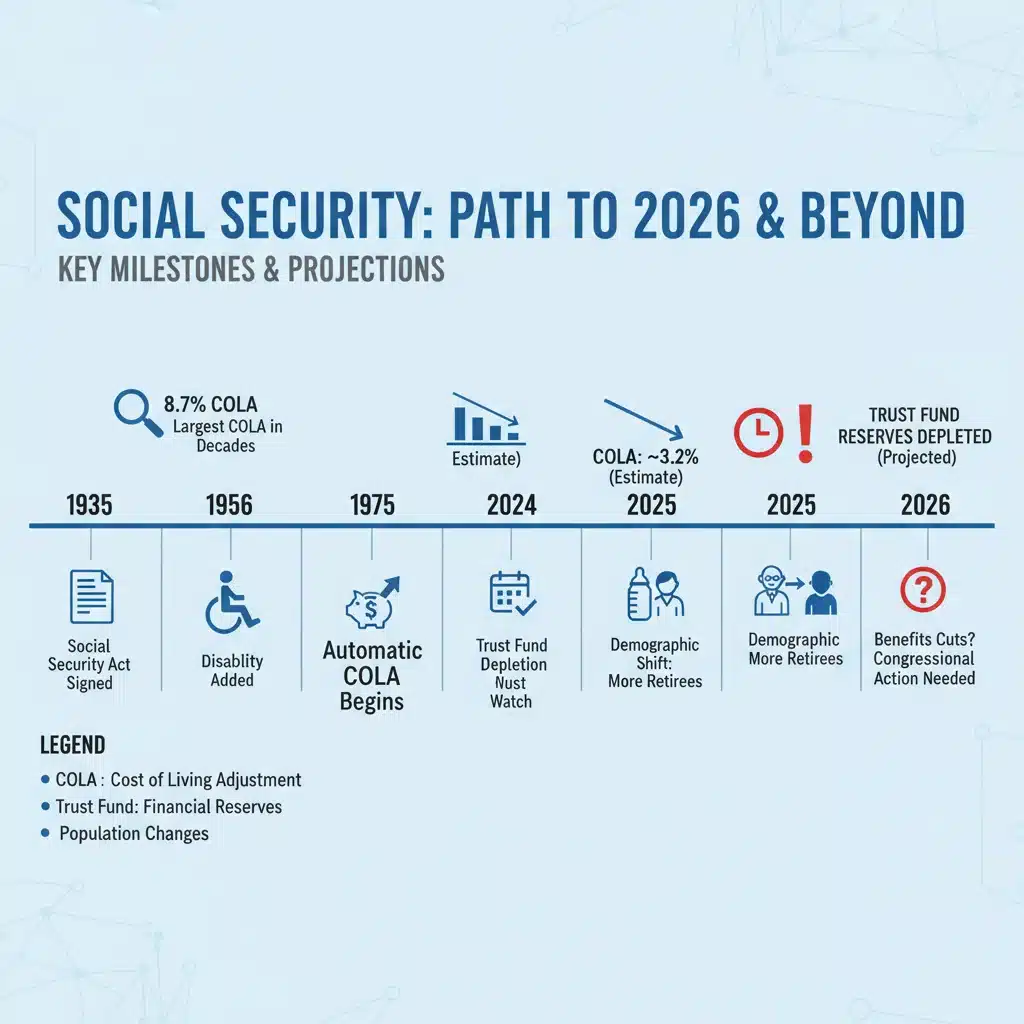
The COLA for 2026 will be announced in late 2025, based on inflation data. Recent years have seen significant COLAs due to high inflation. While inflation is a dynamic economic indicator, retirees should monitor economic forecasts to get an early sense of what the 2026 COLA might look like. A higher COLA can help maintain purchasing power, but it’s essential to remember that it’s a response to rising costs.
Trust Fund Status Update
The annual Trustees’ Report provides detailed projections on the solvency of the OASI and DI trust funds. For Social Security 2026, these reports will continue to project the depletion date of the combined trust funds. Even if the trust funds are projected to be depleted in the future, it does not mean Social Security will cease to exist. It means that without legislative intervention, the program would only be able to pay a percentage of scheduled benefits from ongoing tax revenues.
Changes to Full Retirement Age (FRA)
The full retirement age (FRA) is gradually increasing for those born in 1960 or later, reaching 67 for those born in 1960 and after. By Social Security 2026, individuals reaching FRA will be those born in 1959-1960. Understanding your specific FRA is critical as claiming benefits before this age results in a permanent reduction, while delaying beyond it can increase your monthly payment.
It’s important to differentiate between the FRA and the earliest age you can claim benefits (age 62). Many retirees choose to claim early, but this decision has long-term financial implications. The projections for Social Security 2026 will assume these existing age requirements unless new legislation is passed.
Impact on Future Generations
While this article focuses on current retirees, the projections for Social Security 2026 also hint at the challenges and potential solutions for future generations. The decisions made today, or not made, will have a ripple effect on those planning their retirement decades from now. This intergenerational aspect adds another layer of complexity to the ongoing discussions about Social Security reform.
Strategies for Retirees to Prepare for 2026 and Beyond
Given the ongoing discussions and projections surrounding Social Security 2026, retirees and near-retirees can take several proactive steps to secure their financial well-being.
Stay Informed
Regularly review official reports from the Social Security Administration (SSA) and reputable financial news sources. Understanding the latest projections and legislative discussions will empower you to make informed decisions. The annual Trustees’ Report is a particularly valuable resource.
Review Your Retirement Budget
Assess your current income and expenses. If there are potential changes to Social Security benefits, understanding your budget will help you identify areas where you might need to adjust or where you have flexibility. Consider both essential and discretionary spending.
Diversify Your Retirement Income Streams
Relying solely on Social Security for retirement income can be risky. Diversifying your income with pensions, 401(k)s, IRAs, personal savings, and other investments provides a buffer against potential changes to Social Security benefits. This strategy is critical for long-term financial resilience.
Consider Delaying Social Security Benefits
If your financial situation allows, delaying Social Security benefits beyond your full retirement age can significantly increase your monthly payments. For each year you delay up to age 70, your benefit amount increases by a certain percentage (8% per year for those born in 1943 or later). This is a powerful strategy to maximize your lifetime benefits, especially if you anticipate a long lifespan.
Consult a Financial Advisor
A qualified financial advisor specializing in retirement planning can provide personalized guidance. They can help you understand how Social Security 2026 projections might impact your specific situation, explore strategies for maximizing your benefits, and develop a comprehensive retirement plan that accounts for various scenarios. They can also assist with tax planning related to Social Security benefits.
Explore Part-Time Work Options
For some retirees, engaging in part-time work can supplement income, especially if Social Security benefits are lower than anticipated. This can also provide social engagement and a sense of purpose during retirement.
Understand Taxation of Social Security Benefits
Depending on your combined income, a portion of your Social Security benefits may be subject to federal income tax. Understanding these thresholds and planning accordingly can help you manage your overall tax burden in retirement. Your financial advisor can provide insights into minimizing taxes on your benefits.
The Long-Term Outlook for Social Security
Beyond Social Security 2026, the long-term outlook for the program remains a topic of considerable debate and analysis. While the system faces challenges, it’s important to remember that Social Security has a strong foundation and bipartisan support for its continuation. The discussions often revolve around how to best ensure its solvency for future generations, rather than whether it will exist at all.
Potential solutions to address the long-term solvency include:
- Increasing the full retirement age: Gradually raising the age at which individuals can receive full benefits.
- Adjusting the COLA formula: Modifying how cost-of-living adjustments are calculated.
- Raising the payroll tax rate: Increasing the percentage of earnings contributed to Social Security.
- Increasing the taxable earnings cap: Applying Social Security taxes to a larger portion of high earners’ incomes.
- Modifying the benefit formula: Adjusting how initial benefit amounts are calculated.
Each of these options has its proponents and detractors, and any significant changes would likely be the result of extensive legislative negotiation. For retirees, understanding these potential long-term changes can help in developing a robust and flexible retirement plan.

The goal of these discussions is to ensure that Social Security can continue to fulfill its promise to provide a safety net for millions of Americans. While the specific outcomes are uncertain, the ongoing dialogue ensures that the program’s challenges are being addressed.
Common Misconceptions About Social Security’s Future
It’s easy to get caught up in alarmist headlines regarding Social Security. Let’s address some common misconceptions related to the future of the program, including the outlook for Social Security 2026 and beyond:
- “Social Security will run out of money.” This is perhaps the most common misconception. Even if the trust funds are depleted, Social Security will still be able to pay a significant portion of scheduled benefits from ongoing payroll tax revenues. It would likely mean a reduction in benefits, not a complete cessation.
- “My Social Security benefits will disappear.” As mentioned, the program will continue to pay benefits. The question is whether it can pay 100% of scheduled benefits without changes.
- “There’s nothing I can do to prepare.” This article highlights numerous proactive steps retirees can take to prepare for potential changes, from diversifying income to consulting financial advisors.
- “Social Security is a Ponzi scheme.” Social Security is a social insurance program, not an investment scheme. It is funded by current workers for current beneficiaries, with a trust fund reserve. It has a legal and governmental backing that differs fundamentally from a Ponzi scheme.
Dispelling these myths is crucial for maintaining a realistic and constructive perspective on Social Security’s future. Informed decision-making relies on accurate information, not fear-mongering.
Conclusion: Navigating Social Security 2026 with Confidence
The projections for Social Security 2026 offer a snapshot into the ongoing evolution of a vital retirement program. While challenges exist, the system is resilient, and there are numerous strategies retirees can employ to ensure their financial security. By staying informed about the latest reports, understanding the key factors influencing benefits, and proactively planning your retirement income, you can navigate the future with greater confidence.
Remember, Social Security is a dynamic system, subject to economic shifts and legislative decisions. Your active engagement in understanding its future, coupled with sound financial planning, is your best defense against uncertainty. Whether it’s reviewing your budget, diversifying your investments, or seeking expert advice, taking control of your financial destiny is paramount. The journey towards a secure retirement involves continuous learning and adaptation, and understanding Social Security 2026 is a significant step in that journey.
The future of Social Security will continue to be a subject of national conversation, and as a retiree or near-retiree, your awareness and preparation are your greatest assets. By focusing on what you can control – your personal finances and planning – you can ensure that you are well-positioned for whatever the future holds for Social Security and your retirement.